Why Lighting Language Is Your Highest‑Use Prompt Tool
In AI video, you can change the lens, the camera move, even the art style—yet one variable will dominate how your scene feels: light. Time-of-day defines color temperature and contrast. Key placement sculpts faces. Atmospherics carve depth. These aren’t vague “vibes.” They’re physical cues models latch onto consistently.
Ask any cinematographer: you can shoot the same blocking three ways and deliver three stories, just by shifting the light. The same is true in Veo 3, Kling 3.0, Seedance 2.0, and Sora 2 previews. When your prompt names a concrete lighting look—“low-key with a single rim light,” “blue hour city with sodium spill,” “three-point studio, soft key 45°”—you’re giving the model a map. Mood words help, but lighting language does the heavy lifting.
Nexvy unifies 30+ image, video, audio, and music models behind one interface, so you can maintain that lighting language across engines. The Lighting tab in Nexvy’s StylePicker uses a five‑category taxonomy that travels well between models. Below is a complete reference: 31 looks with reliable prompt fragments, what to expect on screen, and quick pairings that tend to sing.
The 31 Cinematic Lighting Looks: Prompt Fragments, Cues, Pairings
Time of Day
- Golden hour — Prompt: “golden hour sunlight, warm amber backlight, long soft shadows, sun low on horizon.” Cues: glowing rim on hair, flared highlights, warm skin. Pairings: handheld 35mm + slight lens flare; 2.39:1 anamorphic.
- Blue hour — Prompt: “blue hour twilight, cool cyan ambient, practicals just turning on, soft contrast.” Cues: cobalt skies, gentle speculars, calm mood. Pairings: locked-off tripod + 50mm; subtle haze filter (Black Pro‑Mist 1/8).
- Dawn — Prompt: “pre‑sunrise dawn, pastel cool‑warm split, low mist, soft top‑light.” Cues: pink/peach horizons, dew haze, sleepy motion. Pairings: slow dolly‑in + 40mm; 24fps with light motion blur.
- Twilight — Prompt: “post‑sunset twilight, deep blue ambient, silhouette shapes, practical sodium spill.” Cues: rich silhouettes, streetlights pop. Pairings: silhouette blocking + 85mm; gentle parallax drone glide.
- Midnight — Prompt: “midnight darkness, sparse pools of light, high contrast, deep blacks.” Cues: isolated subjects, negative fill, color noise avoided. Pairings: slow push‑in + 35mm; rain gloss for specular interest.
- Harsh noon — Prompt: “high sun, hard top‑light, crisp shadows, minimal fill.” Cues: raccoon eyes, razor shadow edges, bleached highlights. Pairings: wide 24mm + static; desert or concrete settings.
Mood Lighting
- Candlelight — Prompt: “single candle key, warm 1800–2200K, flicker, deep falloff, practical flame visible.” Cues: soft wrap, dancing shadows, intimate faces. Pairings: close 85mm + shallow DOF; locked‑off.
- Neon noir — Prompt: “wet street, cyan‑magenta neon signage, hard contrast, black pockets.” Cues: saturated reflections, colored edges on cheeks. Pairings: handheld 35mm + rain; slow rack focus.
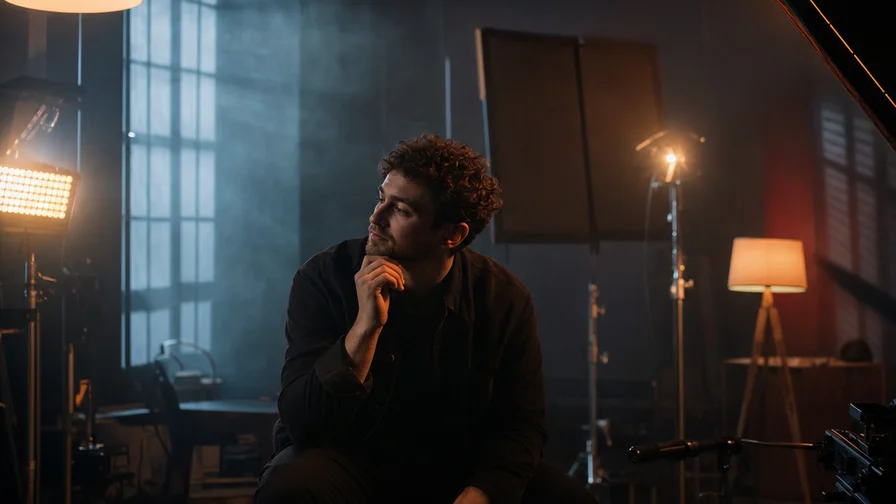
- Moody — Prompt: “low‑key contrast, single side key, negative fill, minimal bounce.” Cues: carved cheekbones, rich blacks. Pairings: shoulder rig 50mm; smoker haze for depth.
- Dreamy — Prompt: “soft diffused light, bloom, halation, lifted blacks, gentle pastel palette.” Cues: glowing highlights, low micro‑contrast. Pairings: slow gimbal float + 40mm; Pro‑Mist 1/2 look.
- Mysterious — Prompt: “backlight through haze, silhouettes, shafts of light, obscured faces.” Cues: god rays, outline‑only subjects. Pairings: slow lateral dolly + 35mm; fog machine cues.
- Romantic — Prompt: “warm soft key, practical fairylights, gentle backlight, subtle lens flare.” Cues: warm skin, twinkle bokeh. Pairings: 50mm + handheld micro‑jitters; sunset interior window.
Studio Setups
- High‑key — Prompt: “high‑key studio, large soft key, white cyc, even fill, low contrast.” Cues: minimal shadows, bright background. Pairings: 35mm + slider; product beauty shots.
- Low‑key — Prompt: “low‑key studio, single hard key from camera‑left, negative fill, black backdrop.” Cues: deep blacks, sculpted subjects. Pairings: static 85mm portrait; smoke for separation.
- Rembrandt — Prompt: “Rembrandt lighting, key 45° off and 45° up, cheek triangle, subtle fill.” Cues: classic portrait triangle under eye. Pairings: locked 85mm; small bounce camera‑right.
- Butterfly — Prompt: “butterfly lighting, frontal high key above lens, nose shadow under, glamour look.” Cues: even face, shadow under nose. Pairings: beauty 100mm; ring diffusion.
- Three‑point — Prompt: “three‑point lighting: soft key 45°, fill opposite low level, rim/backlight for separation.” Cues: balanced face, hair light outline. Pairings: 50mm interview; medium shot on stools.
- Ring light — Prompt: “ring light around lens, frontal soft glow, circular eye catchlights.” Cues: flat shadows, crisp skin detail. Pairings: 35mm vlogger framings; slight tilt‑up for style.
- Rim light — Prompt: “strong back rim from behind subject, minimal key, dark background.” Cues: glowing edges, face mostly shadow. Pairings: 50mm profile; smoke or dust motes.
- Split light — Prompt: “split lighting, hard key 90° from one side, zero fill.” Cues: face half in darkness, dramatic line. Pairings: 85mm tight portrait; slow push‑in.
Natural Atmospherics
- Overcast — Prompt: “overcast sky, huge softbox look, cool neutral, no hard shadows.” Cues: even exposure, calm palette. Pairings: wide 28mm walking shots; gentle wind in hair.
- Foggy — Prompt: “dense fog, low contrast, volumetric depth, desaturated.” Cues: layered silhouettes, softened edges. Pairings: slow parallax + 35mm; headlights cutting haze.
- Sunny — Prompt: “clear sunny day, hard sunlight, blue sky bounce, bright highlights.” Cues: crisp skin sheen, hard ground shadows. Pairings: 24mm beach run; high shutter sport look.
- Rainy — Prompt: “rain at night, wet asphalt sheen, specular reflections, backlit raindrops.” Cues: glistening surfaces, texture in air. Pairings: 35mm handheld; neon practicals.
- Snowy — Prompt: “snowfall, bright overcast, cool tint, breath vapor, soft floor bounce.” Cues: high albedo fill, gentle flurries. Pairings: 50mm + slow motion; red wardrobe pop.
Stylistic Tropes
- Cinematic — Prompt: “cinematic contrast, soft roll‑off, filmic highlights, subtle grain, 24fps, 2.39:1.” Cues: balanced lively range, tasteful blacks. Pairings: dolly + 40mm; gentle vignette.
- Film noir — Prompt: “film noir, hard keys, Venetian blind shadows, cigarette smoke, deep blacks.” Cues: patterned light, mystery. Pairings: 50mm static; slow tilt reveals.
- Cyberpunk — Prompt: “humid night, neon overload, magenta/teal gels, holographic spill, haze.” Cues: saturated fog glow, specular chaos. Pairings: Steadicam weave + 35mm; rain curtains.
- Retro neon — Prompt: “1980s neon, saturated gels, practical neon tubes, VHS halation.” Cues: magenta/cyan backlights, purple blooms. Pairings: zoom push + 24–70mm; synth skyline.
- Horror — Prompt: “underlighting, practical flicker, long falloff, green cast, negative fill.” Cues: eye sockets shadowed, uneasy color. Pairings: slow creeping dolly; Dutch angle 35mm.
- Fantasy — Prompt: “ethereal god rays, warm/cool split, floating particles, enchanted glow.” Cues: shafts through canopy, glitter motes. Pairings: crane rise + 32mm; orchestral swell timing.
How to Stack Lighting With Director and DP Signatures
Once your lighting is locked, layer a directing or cinematography voice for taste. Keep the light directive explicit; use the director as seasoning, not the core instruction:
- Low‑key + Fincher — “low‑key studio, single side key, negative fill” + “Fincher‑style precision framing, cold palette, stable camera.” Expect immaculate geometry and controlled blacks.
- Golden hour + Lubezki — “golden hour backlight” + “Lubezki naturalism, continuous long take, handheld float.” Expect warm wrap and human, breathing camera movement.
- Neon noir + Wong Kar‑wai — “neon magenta/cyan, wet streets, deep shadows” + “Wong Kar‑wai/Christopher Doyle saturated color, slow motion, step‑printing feel.” Expect drenched color and dreamy time.
- Harsh noon + Villeneuve — “hard top‑light, minimal fill, desert glare” + “wide frames, contemplative pacing.” Stark, existential frames with punishing sun.
- Overcast + Deakins — “overcast soft top‑light” + “Roger Deakins even tonality, gentle negative fill, naturalism.” Clean shape without flashy tricks.
- Horror + Eggers — “underlighting, candle practicals” + “Robert Eggers period texture, slow dread.” Candlelit terror with deliberate patience.
Tip: put the lighting fragment early, then the director/DP note, then camera and lens, then action. Models read left‑to‑right; leading with light preserves priority.
Frequent Prompting Mistakes and How to Fix Them
- Vague mood words — “make it moody” alone doesn’t anchor the model. Fix: “low‑key, single side key, negative fill” or “blue hour ambient, deep shadows.” Mood is the result; lighting is the recipe.
- Conflicting time cues — “midnight golden hour” or “harsh noon with long shadows” confuses solvers. Fix: choose one time of day; if you need stylization, say “midnight with sodium pools” or “sunset backlight.”
- Over‑stacking studio terms — “ring light + Rembrandt + split light” will average into mush. Fix: pick one scheme. If you must blend, phrase the hierarchy: “Rembrandt with subtle rim; no ring light.”
- Forgetting fill and negative space — AI often fills everything. Fix: add “negative fill, deep blacks, no ambient bounce” for drama, or “even fill, lifted blacks” for commercial brightness.
- Atmospherics without illumination — “foggy” without a back or side light yields flat gray. Fix: pair “foggy” with “strong backlight/god rays” to sculpt volume.
- Lenses that fight the light — Ring light + 24mm extreme closeup exaggerates distortion; harsh noon + beauty closeup reveals pores. Fix: align lens to purpose: 85–100mm for faces, 24–35mm for space.
- Ignoring exposure logic — Midnight + sky full of detail + face perfectly lit is contradictory. Fix: add a practical source in scene: “dim window spill” or “phone glow” to justify visible faces.
- Prompt order drift — Burying light at the tail encourages models to override it. Fix: put light first, then style, then movement, then action, then environment.
Per‑Model Notes: What Survives Across Veo 3, Kling 3.0, Seedance 2.0, Sora 2
Different engines weigh light cues differently. Here’s what tends to stick and what to watch for, based on current public behavior and early access reports:
- Veo 3 — Strong at naturalistic gradients and soft roll‑off. Time‑of‑day and studio terms (“Rembrandt,” “three‑point”) usually map well. It can soften low‑key into safe contrast; reinforce with “deep blacks, minimal fill.” Volumetric fog reads nicely but can slow generation at higher durations or resolutions.
- Kling 3.0 — Excels with neon, rain gloss, and fast motion. “Neon noir,” “cyberpunk,” and “rainy night backlight” are sticky. It may over‑saturate magentas; if you want restraint, add “muted grade, limited gamut.” Hard top‑light and split lighting are respected; ring light catchlights are hit‑or‑miss unless you specify “circular catchlight visible.”
- Seedance 2.0 — Character‑centric motion is a strength. Keep lighting fragments compact and early. It respects “backlight through haze” and “high‑key studio” but may blend “low‑key” toward medium contrast unless you also say “negative fill, black background.” Heavy fog or snow can reduce motion coherence; try shorter clips or simpler moves.
- Sora 2 — Previews suggest solid global illumination and physically consistent shadows. Time‑of‑day cues (“golden hour,” “blue hour”) and volumetrics respond well. It can auto‑balance toward naturalism; to keep stylized noir or horror, add “hard shadows, crushed blacks, limited fill” and an explicit practical source.
Cross‑engine tactics that help:
- Anchor with geometry — “single key from camera‑left at 45° elevation” gives models a spatial anchor beyond style words.
- State negatives when supported — If a model or interface supports negative prompting, add “no flat lighting, no overexposed sky” or “no ambient fill” to protect the look.
- Mind credits and budgets — On most providers, duration and resolution, not prompt length, drive credit cost. Volumetrics (fog, snow) and nighttime scenes with many glowing practicals can increase failure rates and retries. On Nexvy, you can switch engines if one chokes on haze or neon without rewriting your look—your LightingPicker selection carries over.
- Repeat lightly — If a cue is essential, a single tasteful repeat helps: “golden hour backlight, golden hour warmth” is often enough; avoid five repeats, which can cause overshoot.
Start Fast: Pick a Look, Then Press Record
Here’s a simple, reliable assembly order you can reuse inside Nexvy:
- Lighting first — Choose one of the 31 fragments above.
- Subject and action — “A runner crosses a wet street” or “a closeup portrait turns toward camera.”
- Camera and lens — “handheld 35mm, slow dolly‑in, 24fps, 2.39:1.”
- Style seasoning — “Wong Kar‑wai color” or “Deakins naturalism” if desired.
- Atmosphere or grade — “haze for light beams,” “subtle grain, soft roll‑off,” “muted grade.”
Nexvy makes it practical to keep this language consistent across Veo 3, Kling 3.0, Seedance 2.0, Sora 2, and more—one prompt, many engines. Open the Lighting tab in the StylePicker, pick “golden hour,” “neon noir,” “Rembrandt,” or any of the 31 above, pair it with a lens and a move, and generate. The fastest way to better AI video is to speak the language of light. Try it on Nexvy and see how quickly your footage feels like cinema.